The Human-Centered Engineering Symposium 2026
The Human-Centered Engineering Symposium
March 5-6, 2026
Siebel Center for Design, University of Illinois Urbana-Champaign
The Symposium brought together educators, practitioners, and researchers from all disciplines of Engineering, to collaborate and share insights on how Human-Centered perspectives inform their work.
The symposium has ended. Thank you to all who participated!
brought to you by:
In collaboration with the Grainger College of Engineering and Siebel Center for Design at the University of Illinois Urbana-Champaign, the Human-Centered Engineering Consortium has hosted the first symposium on Human-Centered Engineering.
The symposium has ended.
Thank you to all who participated!
Revisit highlights from the Symposium through our recap and photo galleries. We’d love for you to share with your networks!


Schedule at a Glance
The Symposium will take place, in-person, at Siebel Center for Design at the University of Illinois at Urbana-Champaign.
*Indicates hybrid session hosted via Zoom.
Symposium Goals
Strengthen national leadership in HCE by fostering cross-sector collaboration among academia, industry, and policy.
Sustain and grow the HCE community through structured knowledge exchange and networking opportunities.
Define strategic priorities for the field by identifying key challenges, opportunities, and directions for future work.
Engineering for People: Purpose, Practice, and Impact
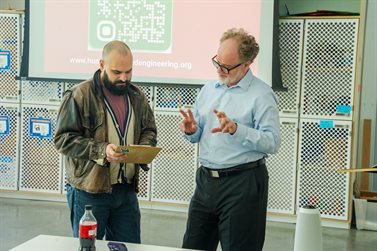
We recently hosted Dr. Brock Craft, teaching professor at University of Washington and co-founder of the HCE Consortium, at SCD. Read our recap of his presentation to get a taste of what will be covered at the Symposium!
Thursday, March 5 - Panel
Illuminating the Evolution of Human-Centered Engineering
This panel brings together voices from research, teaching, student experience, administration, and industry to explore foundational questions such as what does it truly mean for engineering to be human-centered? And how is Human-Centered Engineering distinct from engineering, design, or even human-centered design? Panelists will share perspectives from their own contexts, examining how Human-Centered Engineering reshapes problem framing, technical rigor, stakeholder engagement, ethics, innovation, and impact. Conversations will illuminate the evolving identity of Human-Centered Engineering and invite participants to reflect on what it means for their own work, institutions, and communities.
Friday, March 6 - Information Sessions
10:45am - Teaching and Learning Human-Centered Engineering*
10:45 - 11:55am
Dr. Saad Shehab is the Associate Director of Assessment and Research at the Siebel Center for Design at the University of Illinois Urbana-Champaign. His work focuses on advancing innovation in teaching, learning, and research through human-centered approaches. He collaborates with faculty, students, and institutional partners to design and study transformative educational experiences. Through research, tool development, and cross-institutional collaborations, he works to define, measure, and scale the capabilities that prepare engineers to address complex societal challenges responsibly and effectively.
Dr. Alexander Pagano is the Engineering Education Lead with the Siebel Center for Design's Assessment and Research Team at the University of Illinois Urbana-Champaign. His work introduces research-supported Human Centered Engineering Design methods to undergraduate engineering students so that they may be better prepared to address unmet needs, solve 21st century problems, and close the technology gap. His research is focused on collaborative teams in early design phases, especially the formation of a shared understanding of the problem. He enjoys tinkering in his workshop, designing mechatronic devices that mix tech and art.
12:55pm - Designing Effective Rubrics for ABET Assessment of Human-Centered Engineering Programs
View the Slide Deck
12:55 - 2:05pm
Join us for a practical workshop focused on creating and refining assessment rubrics for ABET-accredited programs. This 70-minute session will begin with a 10-minute overview of best practices and common pitfalls in rubric design, followed by 20-30 minutes of hands-on small group work where participants can apply these principles to actual rubrics—either their own or sample materials provided by the facilitator. We'll wrap up with a discussion of key takeaways and an open Q&A session where attendees can ask questions about rubrics or any other ABET-related topics. This session is designed primarily for faculty in already-accredited programs who have been asked to use rubrics for assessment, but anyone with general questions about ABET accreditation is welcome to attend and participate in the discussion. Sample communication assignment rubrics and student work will be available for those who don't bring their own materials.
Dr. Eileen Webb is President of Accreditation Preparation, since 2012 – helping universities prepare for ABET Accreditation, 70+ universities, 200+ programs, engineering, computing, applied and natural sciences and engineering technology. She has been an ABET Program Evaluator for 21 ABET reviews. She also serves on the AIChE Educataion and Accreditation Committee and as a ABET Board of Delegates member. She has been an Invited Speaker - ABET Symposium, WEEF, LACCEI, Buenas Prácticas de Assessmente en Ingeniería, ACOFI. She continues to work in industry in industrial engineering and quality since 2006 founding Streamline Consulting in 2006, with clients in manufacturing casinos, and government. Prior to this she worked for Procter & Gamble, Weyerhaeuser, Texas Instruments, Nortel and others. Her Bachelor of Chemical Engineering is from Georgia Tech.
12:55pm - Human-Centered Engineering, AI and Ethics
View the Slide Deck
Hosted in Sunset Studio
12:55-2:05pm
This session is a facilitated small-group conversation (approximately 20–30 participants) focused on how AI is reshaping engineering ethics and engineering education. We will use a human-centered engineering framing—centering people, contexts, and consequences—to surface how instructors, students, and institutions are making decisions about what is acceptable, what is risky, and what requires new norms or guidance. Rather than presenting a fixed set of claims, participants will share current practices, tensions, and open questions (such as: appropriate uses of AI in coursework, responsibility and accountability when AI tools are used, equity and access, transparency and disclosure, assessment and academic integrity, and how ethics instruction changes when AI systems are part of the engineering workflow). The goal is to draw out the group’s lived experience and generate a visible set of themes, questions, and possible next steps that participants can take back to their programs.
Dr. Chelsea Salinas is a Teaching Professor and Director of the Design Engineering Bachelor's Program at the Colorado School of Mines. She is an experienced instructor whose expertise spans systems modeling and inclusive design, with scholarship focused on assessment practices and program development. Her teaching centers human-centered approaches to engineering, with a particular emphasis on sociotechnical integration as a framework for addressing the ethical responsibilities engineers carry in their work. She is interested in how engineers and educators can thoughtfully engage with the ethical dimensions of emerging technologies, including artificial intelligence, through a human-centered lens. Dr. Salinas earned a BS in Chemical Engineering from the University of Texas and her MS and PhD in Chemical and Biological Engineering from the University of Colorado.
12:55pm - Surfacing the Future of Human-Centered Engineering:
A Crowdsourced Structural Dialogue
Facilitated by Dr. Georges Ayoub
Hosted in Classroom 1002
12:55-2:05pm
This interactive workshop serves as a structured tension-mapping lab designed to surface and interrogate the systemic barriers shaping the trajectory of HCE. Rather than offering predefined answers, the session crowdsources emergent concerns from symposium participants and works collaboratively to identify the most urgent structural frictions confronting the field. Through facilitated analysis, participants will move beyond idea generation toward structural diagnosis. Each group will identify core tensions, articulate underlying incentive structures, and produce a clear problem statement accompanied by actionable insights.
Dr. Georges Ayoub is an Associate Professor of Industrial and Manufacturing Systems Engineering at the University of Michigan–Dearborn and the founding director of the university’s Bachelor of Science in Engineering in Human-Centered Engineering Design (HCED)—one of the first ABET-accredited programs of its kind in the United States. Through the creation and growth of the HCED program, Dr. Ayoub has been instrumental in integrating engineering rigor with design thinking, human factors, entrepreneurship, and social impact to prepare a new generation of engineers capable of addressing complex, real-world challenges.
12:55pm - Laser Cut Tea Lamps
Facilitated by Neil Pearse
Hosted in The Shop (lower level)
12:55-2:05pm
Learn the basics of our laser lab through this unique, interactive workshop! Make a customized tea lamp with an engraving and leave with the knowledge to do it yourself the next time you visit our shop at SCD. No experience needed! Supplies provided.
Neil Pearse is the Assitant Director of Lab and Equipment Operations at the Siebel Center for design. Utilizing the Human Centered Design process, he develops programming and policies allowing students from every corner of the UIUC community to learn hands on fabrication techniques in order to further their design process.
2:20pm - What’s Next for Human-Centered Engineering?
Charting Future Research Directions Together*
Facilitated by Dr. Cristián Vargas-Ordóñez and Dr. Micah Lande
Watch the Recorded Session
View the Slide Deck
Hosted in Sunset Studio, Hybrid
2:20-3:30pm
This collaborative session will raise big questions, emerging ideas, and shared curiosities shaping the future of research in Human-Centered Engineering. Participants will engage in themed conversations to exchange research questions, methods, and contexts, identifying areas of alignment, productive tensions, and open gaps. Insights will be co-constructed in small groups and then synthesized with the full group. The session will conclude with a brief framing and a few illustrative examples that situate these directions across institutions and settings, leaving the community with a shared view of promising research pathways and opportunities for collaboration.
Dr. Cristián Vargas-Ordóñez is a human-centered engineering researcher whose work bridges engineering education, arts-based inquiry, and social justice. His scholarship examines how compassion, epistemic justice, and interdisciplinary practices shape engineering learning, identity, and design, particularly for historically marginalized communities. Drawing on qualitative methods and creative practices such as puppetry, animated objects, and new media art, his work advances engineering as a relational, reflective, and socially responsible practice grounded in learning with, for, and as people.
Dr. Micah Lande is curious about how people learn and apply design thinking and making in their studies, work, and everyday lives. He is an assistant professor in the Leslie A. Rose Department of Mechanical Engineering at the South Dakota School of Mines & Technology, where he holds the E.R. Stensaas Chair for Engineering Education. He leads the Holistic Engineering Learning Lab & Observatory and teaches courses in human-centered design, innovation, and making.
*Indicates hybrid session hosted via Zoom.